

Listen to this article
For SMEs selling through GCC distributors, revenue disclosures often require closer scrutiny.
Common issues identified by auditors in the UAE include revenue recognised before VAT or customs rules allow, contracts lacking IFRS 15 clauses, missing sell-through documentation, and rebates not recorded as variable consideration. These gaps can lead to audit adjustments and create compliance challenges across multiple jurisdictions.
The root problem? Distributor revenue touches three systems that rarely match:
- The company's UAE accounting records,
- GCC VAT filings, and
- The distributor's actual sell-through and inventory movements.
When any one of these three is misaligned, your revenue is considered unreliable.
This article outlines six key revenue disclosure requirements UAE SMEs should follow when selling through GCC distributors. It covers the IFRS 15, VAT, customs, and audit standards necessary to ensure revenue reporting meets the expectations of banks, regulators, and investors across the region.
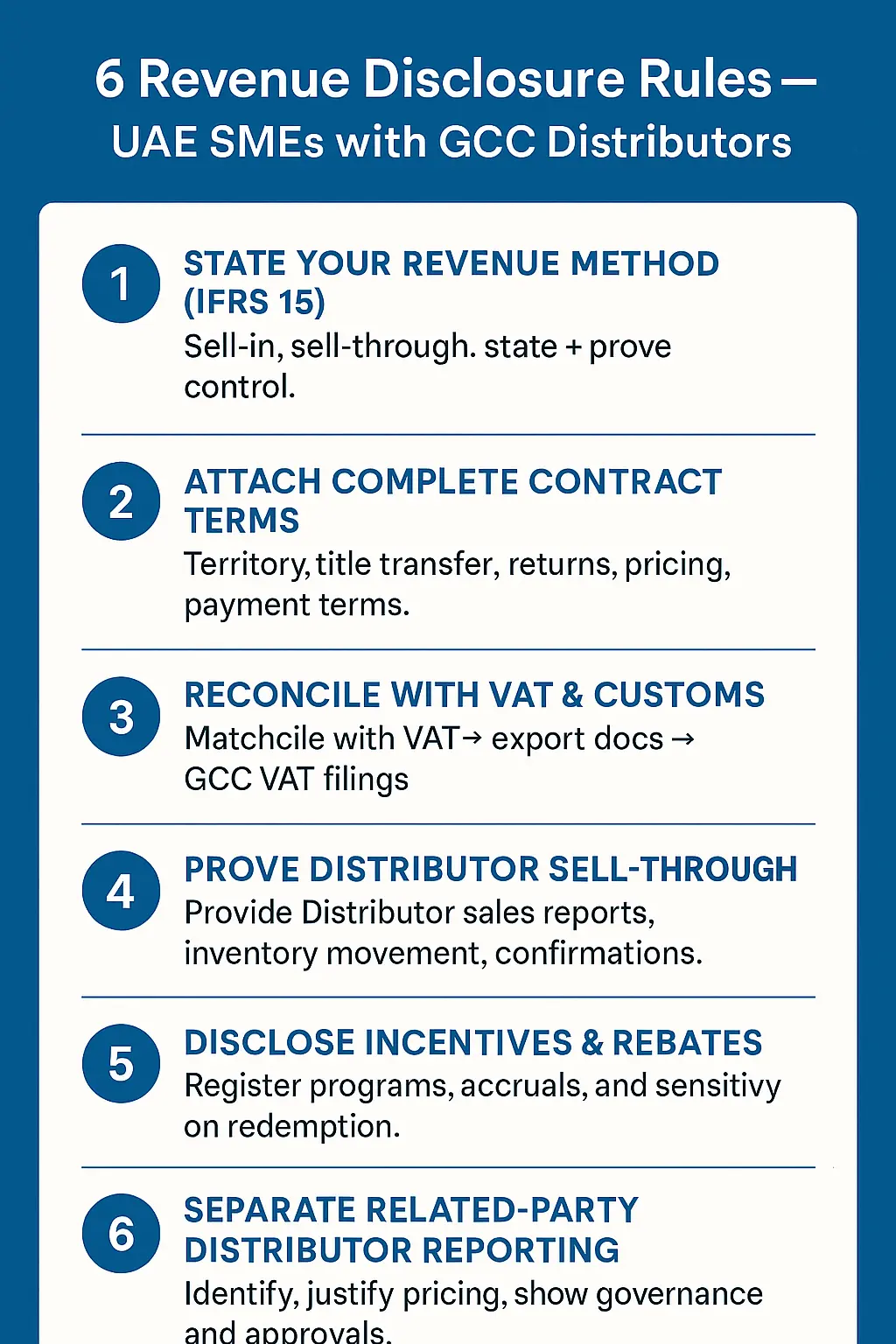
Rule 1: Disclose the Exact Revenue Recognition Method Under IFRS 15
UAE SMEs selling through GCC distributors must state explicitly whether revenue is recognised at shipment (sell-in), delivery, consignment, or only when the distributor sells to the end customer and then prove that the chosen method meets IFRS 15's control-transfer criteria. Auditors repeatedly flag "shipment-based recognition" because physical dispatch alone does not demonstrate control transfer when the distributor still sets pricing, holds return rights, or can move stock freely.
To withstand IFRS 15 scrutiny, SMEs need a documented control assessment for every distributor arrangement. This includes:
- Clear revenue policy disclosure (sell-in vs sell-through vs consignment) with the IFRS 15 indicators applied.
- Contract-level analysis covering title terms, Incoterms, return rights, payment obligations, and any clauses suggesting consignment or continued control.
- Evidence pack: signed contracts, return-rate history, credit terms, billing schedules, and any security deposits or guarantees.
- Sensitivity tables showing how revenue and margin would shift if control indicators were interpreted differently (higher returns, delayed acceptance, variable consideration adjustments).
In short: state the policy, then prove it. The regulator, auditors, and investors expect a contract-backed explanation of why control transfers when you say it does not just a standard accounting policy line in the notes.
Rule 2: Provide Complete Contract Terms With Every Distributor
UAE auditors, regulators, and any IPO due-diligence team will not accept revenue figures unless the underlying distributor contracts clearly define territory rights, return rules, pricing mechanics, and whether the arrangement is consignment or resale. When these clauses are missing or vague, revenue timing under IFRS 15 becomes unverifiable and the audit immediately escalates into a control-transfer review.
To make your revenue defensible, you must produce complete, contract-level documentation:
- Attach each signed distributor agreement showing territory exclusivity and sales rights, return/unsold stock rights, pricing formulae, discounts, and rebate structures, invoicing and payment terms, and explicit wording on consignment vs resale.
- Create a contract matrix: one line per distributor listing territory, contract dates, title-transfer terms, payment cycle, return window, reselling restrictions, and termination clauses. This matrix becomes the prospectus note and cross-checks Rule 1's revenue policy.
- Provide execution evidence: timestamped emails confirming contract acceptance, customs/export documentation tied to the relevant contract, and proof-of-delivery records.
- Update your model inputs: contract-level revenue curves, rebate accrual percentages, return-rate provisions, and a clause-to-IFRS-indicator checklist.
When distributor contracts are complete and evidenced, your revenue disclosures become audit-proof and fully reconcilable with IFRS 15 and GCC cross-border trade documentation.
Rule 3 Align Revenue Disclosures With GCC VAT and Customs Records
If your UAE books say a sale happened on the 5th, but customs exit data shows the shipment cleared on the 11th and the distributor's GCC VAT filing shows it in a different period, auditors will treat it as a control failure. For IPO-bound SMEs, this is one of the most common red flags across SCA reviews: revenue timing isn't considered reliable unless UAE ledgers, export documentation, and destination-country VAT evidence all reconcile.
IFRS requires revenue recognition to be supported by objective evidence of control transfer. In cross-border GCC sales, that evidence is almost always tied to customs and VAT. UAE zero-rating requires valid export documentation; GCC VAT administrations (like ZATCA in KSA) actively cross-check VAT filings with customs systems. Any mismatch in date, value, invoice sequence creates uncertainty around whether the revenue date in your books is defensible.
What you must compile for every shipment:
- Proof of export: airway bill or bill of lading, BOE/exit certificate, commercial invoice, packing list, and (where possible) proof of delivery at destination. These documents jointly support VAT zero-rating and the recognition date.
- A three-way reconciliation: UAE sales ledger → customs export record → distributor's GCC VAT filing. Show matching invoice numbers, amounts, and dates.
- Gap explanations: if UAE books show revenue earlier than customs/VAT timing allows, prepare a timing-difference table and a remediation plan.
- Model adjustments: reflect any timing constraints in your revenue curve, working-capital forecasts, and VAT exposure assumptions.
IPO reviewers will not accept "administrative delay" as an excuse only a clean, documented bridge between accounting entries, customs data, and GCC VAT evidence closes the issue.
Rule 4: Maintain Evidence of Distributor Sell-Through and Inventory Movements
For UAE issuers that sell through distributors, auditors will not rely on your sell-in numbers alone. They expect independent evidence of sell-through, actual sales made by the distributor, not just shipments leaving your warehouse. Without this, revenue timing, return provisions, and inventory risk become unverifiable, and IPO reviewers frequently challenge whether the business is front-loading revenue or masking unsold stock.
IFRS guidance and industry practice draw a clear distinction: when distributors control pricing, stock rotation, or resale channels, sell-through data becomes a required layer of evidence. Logistics frameworks similarly emphasise inventory movement logs as proof of how goods actually flow through the chain, not just exit your books.
Documentation you must maintain:
- Monthly distributor sales reports, signed or electronically verified, plus EDI/CSV extracts and reconciliations against issued invoices. Where feasible, obtain direct distributor confirmations.
- Inventory aging and movement logs: warehouse receipts, stock transfer notes, and inventory roll-forwards that show how shipped volumes translate into distributor stock changes and actual sell-through.
- A disclosed validation method in the prospectus: whether you run periodic third-party audits of distributor inventory, rely on EDI integrations, or match distributor reporting with downstream retail Point of Sale (POS) data. State the frequency, controls, and exception-handling process.
- Product-level sell-through rates, distributor inventory days, return/residual stock assumptions, and sensitivity analyses. These feed directly into conservative revenue recognition, working-capital planning, and disclosures on inventory risk.
Rule 5: Disclose All Incentives, Rebates and Back-End Discounts
In GCC distributor models, rebates and incentive schemes are not commercial afterthoughts, they are variable consideration under IFRS 15. That means they must be estimated upfront, recognised in the same period as the related revenue, and fully disclosed. IPO reviewers scrutinise this because underestimating rebates is a common way revenue gets overstated, especially when "ship-and-debit," target-based incentives, or year-end credit notes are used.
IFRS 15 requires issuers to document the rebate mechanism, estimate the expected utilisation, and disclose the significant judgments behind those estimates. Industry guidance consistently flags variable consideration misstatements as a recurring audit finding.
Documentation you must maintain:
- A complete rebates & incentives register covering each program: eligibility rules, calculation basis, historical utilisation, and the accrual methodology. Tie each accrual back to contract clauses and the relevant invoice sets.
- Historical run-rate and expected redemption analysis for every active scheme. In the prospectus, state the estimation method, the statistical basis, and the justification for why the expected amount is not at significant risk of reversal (or disclose conservatively if uncertainty is high).
- Sensitivity tables showing the revenue and margin impact under low/medium/high rebate utilisation scenarios to demonstrate judgment quality and risk awareness.
Rule 6: Report Related-Party Distributor Reporting
When a GCC distributor is owned by founders, family members, or affiliated shareholders, the transactions fall under related-party rules, and regulators treat them as high-risk. IFRS requires separate disclosure, clear arm's-length pricing justification, and transparent governance approvals. During due diligence, undisclosed related-party distributors are one of the fastest triggers for red flags because they distort revenue quality, margin comparability, and independence of controls.
Documentation you must maintain:
- A related-party register identifying each connected distributor, with transaction volumes, pricing terms, margin profiles, contract copies, and evidence of board approval.
- Pricing justification using market comparables, third-party valuations, or transfer-pricing support to demonstrate that terms mirror arm's-length conditions. Include board minutes and conflict-of-interest declarations for completeness.
- Separate prospectus disclosure showing related-party revenues, margins, and oversight structures, and explaining how management prevents preferential treatment or channel stuffing.
- Model inputs: a separate pro-forma analysis comparing related-party vs third-party margins, adjustments to EBITDA if non-arm's-length elements need normalisation, and explicit disclosure of governance mitigations.
Clear, separate reporting ensures investors can trust the revenue stream and protects SMEs from major issues in audit, diligence, and listing review.
"Audit Red Flag" Checklist: Is Your Revenue Report a Liability?
Before an auditor or investor dives into your books, they look for these specific "cracks" in your GCC (Gulf Cooperation Council) distributor model. If more than two red flags apply, your revenue recognition process may be at risk of a material adjustment.
- The "Ship-and-Forget" Approach: You recognise 100% of revenue the moment goods leave the JAFZA (Jebel Ali Free Zone) or KIZAD (Khalifa Industrial Zone Abu Dhabi) port, regardless of whether the distributor has the right to return unsold stock.
- The Customs-Ledger Gap: Your sales ledger date is December 28th, but your Bill of Entry (BOE) or Customs Exit Certificate is dated January 5th.
- The Invisible Rebate Liability: You offer volume bonuses or marketing support to distributors but only record them when you actually pay the cash, rather than recognising and accruing them at the time of sale.
- The Blind Sell-Through Gap: You have no idea how much stock is sitting in a warehouse in Riyadh or Muscat; you only track what left your warehouse in Dubai.
- The Handshake Affiliate: You sell to a distributor owned by a family member without a formal, board-approved transfer pricing agreement (informal related party transaction).
Case Study: The "Sales Return" Surprise and the $1M Restatement
The Scenario: A high-growth UAE electronics SME (Small and Medium-sized Enterprise) secured a major contract with a KSA (Kingdom of Saudi Arabia) distributor. To hit year-end targets, they shipped $1,000,000 worth of inventory in December and recorded it as full revenue.
The Crisis: In February, the distributor exercised a right-of-return clause hidden in a side letter, returning $200,000 of unsold stock. Simultaneously, the SME applied for a bank loan to fund expansion.
The Fallout: Because the SME had not estimated variable consideration (Rule 5) or created a return reserve in their December filing, the auditor flagged the revenue as overstated.
The Result: The SME was forced to restate their year-end financials, their net profit dropped by 20%, and the bank rejected their loan application due to unreliable financial reporting.
Expert Take: Under IFRS 15 (Revenue from Contracts with Customers), revenue isn't what you bill; it's what you expect to keep. Without a historical return-rate analysis, your top line is just a placeholder.
The 90-Day Roadmap: A Strategic Action Plan for CFOs
Address disclosure gaps proactively before audit season begins. Use this quarterly sprint to bring your GCC operations into full compliance.
Phase 1: Days 1–30, The Contractual Deep-Dive (Rule 2)
Goal: Move from handshake deals to IFRS-ready documentation.
Action: Conduct a comprehensive audit of all distributor agreements. Ensure every contract explicitly defines Incoterms, title transfer, and return rights.
Deliverable: A contract matrix that summarises revenue triggers for every GCC territory.
Phase 2: Days 31–60, The Customs and VAT Reconciliation Sprint (Rule 3)
Goal: Ensure your accounting software speaks the same language as customs.
Action: Build a triple-match workflow. Every sale in your ledger must be cross-referenced with a Bill of Entry and a zero-rated VAT export certificate.
Deliverable: A monthly reconciliation report that explains any timing differences between shipment and recognition.
Phase 3: Days 61–90, Implementing the Sell-Through Engine (Rule 4)
Goal: Gain visibility beyond the border.
Action: Mandate monthly inventory and sales reports from your GCC distributors. If possible, integrate their stock data into your ERP to track real-time movement.
Deliverable: A stock aging dashboard that justifies your revenue recognition timing and inventory valuation.
CFO Bridge: Strategic Financial Leadership in Dubai, Abu Dhabi, and Riyadh
CFO Bridge provides specialised fractional CFO and virtual financial officer services to SMEs scaling across Dubai, Abu Dhabi, and the wider MENA region. As a leading financial partner in the UAE, we bridge the gap between local accounting and international standards like IFRS 15. Our expertise extends into Saudi Arabia, where we support businesses navigating ZATCA e-invoicing mandates and cross-border tax compliance in Riyadh. By integrating professional governance with regional market insights, CFO Bridge helps businesses transform regulatory requirements into sustainable growth across the Middle East.
Conclusion
Exchanges, auditors, and regulators want one thing: a provable audit trail that links your contracts, recognition method, VAT/customs filings, sell-through data, rebate calculations, and related-party governance. If any link breaks, revenue reliability becomes a question mark in audit, diligence, or a future IPO review.
This is where CFO Bridge stands apart. We specialise in UAE cross-border revenue compliance and understand exactly how ZATCA, FTA, auditors, and merchant bankers test these disclosures. Our team reconstructs the underlying evidence, builds contract-level schedules, aligns VAT/customs data, validates distributor sell-through, and prepares IFRS-compliant disclosure packs that withstand scrutiny.
If you want to benchmark your readiness, start with a structured 6 to 8-week Revenue Disclosure Audit: a gap matrix, contract and VAT reconciliation sprint, rebate/variable-consideration review, and related-party governance assessment.
Have questions about your UAE finances?
Talk to a fractional CFO who's solved this before.
Frequently Asked Questions
Clearly state sell-in, sell-through, or consignment method, and provide contract-backed proof showing control transfer to meet IFRS 15 requirements.
Auditors and regulators need proof of actual sales and inventory movements to verify revenue timing, returns, and control under IFRS 15.
They are variable considerations under IFRS 15, requiring upfront estimation, disclosure, and sensitivity analysis to ensure revenue isn't overstated.
Not necessarily. Under IFRS 15, revenue is recognised only when control passes. If your distributor has the right to return unsold goods or you still dictate the final selling price, an auditor may argue that control hasn't fully transferred. Recording revenue too early, at sell-in instead of sell-through, is a major red flag that can lead to profit restatements during a sale or IPO.
Incentives are considered variable consideration. If you don't estimate and deduct these from your top-line revenue upfront, your earnings (EBITDA) will look artificially high. A sophisticated buyer will perform a quality-of-earnings report; if they find unrecorded rebate liabilities, they will likely demand a valuation haircut or a lower purchase price.
This is a high-risk compliance gap. The Federal Tax Authority and GCC customs authorities such as ZATCA use these documents to verify VAT zero-rating. If a buyer sees a mismatch, they will view it as a potential tax liability, which in extreme cases can lead to heavy penalties and the freezing of cross-border trade privileges.
The gold standard is a triple-match reconciliation: a contract with clear IFRS 15 clauses on when control transfers, validated customs and exit documents tied to every invoice, and regular sell-through reports from the distributor confirming the goods reached the end customer.